
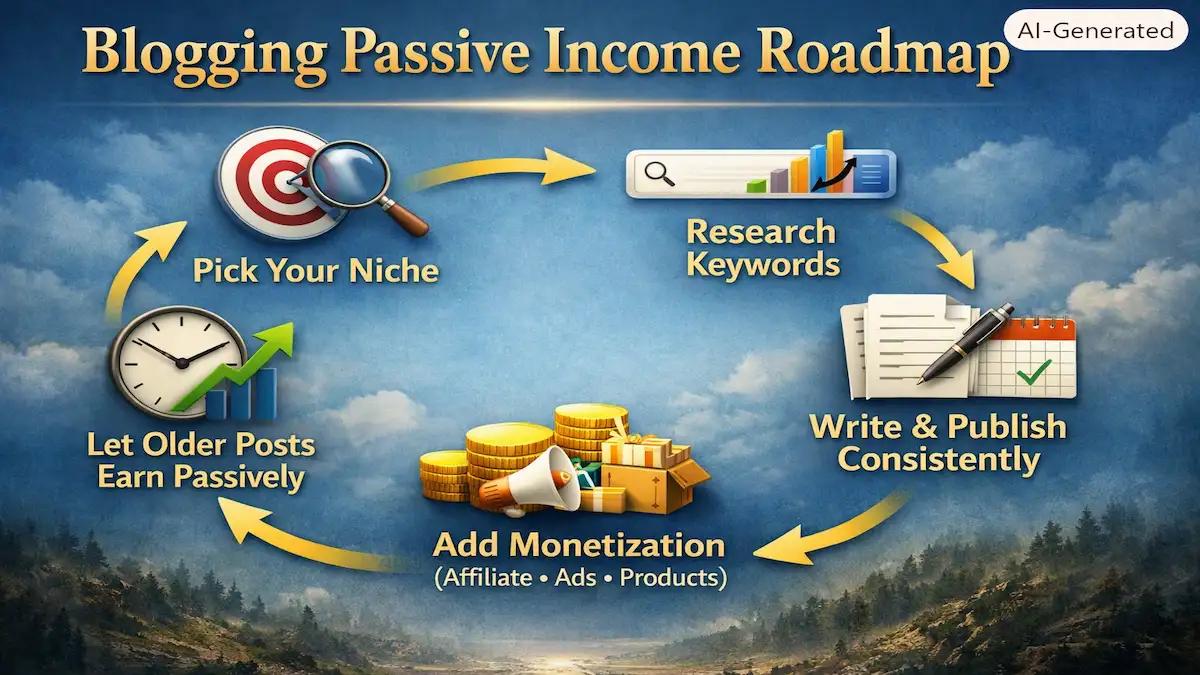
How to Start Blogging for Passive Income?
Start blogging for passive income by picking a niche that we can write about consistently, publishing content built around real search demand, and layering in monetization like affiliate marketing once we have steady traffic. It is not instant. Most beginners need 6 to 12 months of consistent publishing before they see meaningful income, and the “passive” part only kicks in after that groundwork is done.
Table of Contents
I know that is not what people want to hear when they search “passive income.” But it is the honest starting point, and it is what actually helps you plan properly instead of quitting three months in when nothing seems to be happening yet.
Most articles on this topic either oversell how fast this works or bury the real mechanics under vague encouragement. This one walks through the actual steps, the actual timeline, and the actual costs, so you can decide with clear eyes whether this is the right path for you right now.
My Own Path Into Blogging
Like a lot of people, I tried paid surveys first. They filled small pockets of time but never turned into anything sustainable. Eventually I found Wealthy Affiliate and started learning affiliate marketing properly, which led to blogging becoming the main way I build income online today, alongside a separate physical product business I also run.
Check my review on Wealthy Affiliate here
I am not sharing this to suggest blogging is easy or that results are guaranteed. I am sharing it because the path from curious beginner to someone who actually understands how this works is longer than most articles admit, and I would rather say that upfront.
Why Blogging for Passive Income Still Matters
Blogging has been declared dead more times than I can count, and it keeps outliving the prediction. Nowadays, a few things make it particularly relevant for beginners looking for income that does not require trading hours for money forever.
Search behaviour has shifted toward AI Overviews and conversational search, which sounds like bad news for blogs. In practice, it rewards content that answers questions clearly and specifically, which is exactly what a well-written blog post does better than a thin product page or a social caption.
Blogs also remain one of the few online assets you fully own. A social account can be suspended or deprioritised overnight by an algorithm change. A blog you own keeps working even when platforms shift around it, as long as you keep it useful and current.
There is also a quieter shift worth naming. As more content online becomes AI-generated and interchangeable, genuinely experienced, specific writing stands out more than it used to, not less. Readers and search engines are both getting better at spotting the difference.
Current Trends Shaping Beginner Blogging Right Now
AI-assisted writing is everywhere now, which means generic, unedited AI content is easy to spot and increasingly ignored by both readers and search engines. Blogs that blend real personal experience with clear structure are outperforming ones that read like everyone else’s.
Niche specificity matters more than it used to. Broad lifestyle blogs struggle to rank against sites that go deep on one topic. Beginners who pick a focused niche and stay in it tend to see traction faster than those trying to cover everything at once.
Multiple income streams per blog are also becoming standard. Rather than relying only on display ads, bloggers are combining affiliate marketing, digital products, and sometimes services, so income is not dependent on a single source.
Search engines are also placing more weight on demonstrated experience rather than just keyword coverage. This means a blog written by someone who has actually done the thing they are writing about has a real structural advantage over one that has simply researched the topic secondhand.
The Step-by-Step Roadmap to Start Blogging for Passive Income
Start by choosing a niche based on two things: something you can write about consistently for a year or more, and something with genuine search or buyer intent behind it. A niche you enjoy but nobody searches for will not build income, no matter how well you write.
Once you have a niche, choose a platform. WordPress remains the standard choice for anyone serious about long-term blogging, mainly because you own the site fully and are not restricted by a third-party platform’s rules.
Hosting and a domain typically cost a modest monthly amount, and most beginners can start with a basic plan rather than anything premium.
Next, do keyword research before writing a single post. This step gets skipped constantly by beginners, and it is the biggest reason blogs fail to get traffic. Tools like Jaaxy show actual monthly search volume and competition level, so you write about what people are searching for rather than guessing.
If you want the full breakdown of getting started with affiliate marketing alongside blogging, I have covered that in more depth in [How to Start Affiliate Marketing the Easy Way].
With keywords in hand, write your first 10 to 15 posts around genuine search intent, meaning each post should answer a specific question your reader actually has. Posts that open with a direct answer, then build out detail, tend to perform better with both readers and AI Overviews.
After you have a foundation of content, start building monetization in layers. Affiliate marketing is usually the most accessible starting point because it requires no product creation or inventory.
Display ads can be added once you have consistent traffic, typically a few thousand monthly visitors. Digital products come later, once you understand your audience well enough to know what they would pay for.
Consistency matters more than perfection throughout. A blog with 40 decent posts published over 8 months will usually outperform one with 5 perfect posts published sporadically over the same period. Search engines reward steady publishing patterns, and readers are more likely to return to a blog that updates regularly.
It also helps to revisit and update older posts every few months rather than only publishing new ones. Search rankings shift as competitors publish and as your own content ages, and a post that ranked well a year ago can slip if it is never refreshed with current information.
This maintenance work is part of what keeps a blog earning steadily over time instead of tapering off after the initial publishing push.
Common Mistakes Beginners Make in Blogging
Skipping keyword research is the most common mistake, and it deserves repeating. Writing about what you think people want, instead of what data shows people actually search for, wastes months of effort on content nobody finds. This is different from simply picking topics you find interesting. It means checking actual search volume before you commit hours to a post.
Choosing a niche based purely on passion, without checking search demand or monetization potential, is another frequent trap. Passion helps you stay consistent, but it does not create an audience on its own. A niche needs both interest and demand to work long term.
Adding affiliate links or ads too early, before there is any traffic to see them, costs beginners credibility more than money. Readers can tell when a nearly empty blog is already trying to sell them something, and it undermines trust before any has been built.
Publishing inconsistently, where a beginner writes five posts in one enthusiastic week and then nothing for two months, is a specific pattern that quietly kills a lot of blogs. Search engines and readers both respond better to steady output than to bursts followed by silence.
Giving up around the 3 to 4 month mark is extremely common, right around the point where growth is slowest and least visible. This is usually the stage right before momentum starts building, which makes quitting here particularly costly.
Ignoring on-page SEO basics, like using your target keyword in the title, intro, and headings, is another gap I see often. It is a small habit that compounds significantly as search engines index more of your content.
Copying competitor content structure without adding anything new is another mistake worth naming directly. It is tempting to look at what already ranks and repeat the same format, but search engines and readers both respond to content that adds something the existing top results do not already cover, whether that is more specific detail, a different angle, or genuine first-hand experience.
What I Have Learned Building Blogging Myself
Building an affiliate marketing business through blogging has taught me that the “passive” label is a bit misleading for the first stretch. The early months are genuinely active work: research, writing, learning SEO basics, and adjusting based on what is and is not working.
What changes over time is the ratio. Early on, almost everything is active effort. Later, older posts that still rank in search continue bringing in readers, and in some cases income, without me touching them again. That is where the passive part actually starts to show up, but it takes real groundwork to get there.
The hardest part for me was not the writing itself. It was staying consistent during the stretch where nothing seemed to be happening yet, before search engines had indexed enough content to send meaningful traffic. That waiting period is rarely talked about honestly, and it is often where people quit closest to when things would have started moving.
I built my own site around this exact approach, focusing on genuinely useful content rather than rushing to monetise before there was an audience to monetise. It has been a slower build than I expected going in, but a steadier one too. For more on how I structure content and tools around this, I have written about it on smartincome.pickyaura.com’s Resources.
It is also worth being honest about the limitations. Blogging is not a fast income method, it requires ongoing content updates as search trends shift, and it does not work well as a side project you touch once a month. Anyone weighing this against other online income methods should factor that in before starting.
There is also no guaranteed outcome. Two people can follow the same steps and see different results depending on their niche, their consistency, and factors outside their control like shifts in how search engines rank content.
What is realistic to expect is steady, gradual progress if the fundamentals are followed properly, not a fixed number or a fixed date.
Where to Learn the Full Blogging Process
If you want a structured way to learn blogging and affiliate marketing together, rather than piecing it together from scattered articles, Wealthy Affiliate is the platform I used to learn this and the one I still use today. It combines training, keyword research tools, and hosting in one place, which is useful when you are starting from zero and do not want to juggle several subscriptions.
There is a free starting tier, which lets you explore the training and build an initial site before deciding whether to upgrade. This matters if you are the kind of person who wants to test something properly before spending money on it, rather than committing upfront based on promises alone.
You can look at what it includes here: Wealthy Affiliate
It is not a shortcut and will not remove the timeline mentioned earlier. What it does is give you a clearer structure to follow instead of guessing your way through the first year.
Final Thoughts
Starting a blog for passive income in 2026 is still a realistic goal, but it works best with accurate expectations. The first several months are active building, not passive income. What you are creating is an asset that, if built on real search demand and maintained honestly, can keep working for you well after the initial effort.
If you are serious about it, start with niche selection and keyword research before writing anything, and commit to at least 8 to 12 months before judging whether it is working. If you want a guided path through affiliate marketing as part of that process you can explore the training platform I use here: Wealthy Affiliate.
Looking back, the version of me who first started this had no real idea what the early months would actually feel like. I did not have a mentor telling me it was normal to feel like nothing was working while the groundwork was quietly being laid. If this article does one thing, I hope it is that.
Not a promise that this will be easy, but reassurance that the slow part is normal, and that it does pass if you keep showing up for it.
If you are standing at the same starting point I was once at, wondering whether this is worth trying, my honest answer is that it is worth trying properly, with realistic expectations, rather than half-heartedly with unrealistic ones.
That difference alone tends to decide who is still blogging a year from now and who has already moved on to the next thing.
Everything else in the article stays as it was in the previous version. Let me know when you’re ready to tackle the real smartincome.pickyaura.com URLs for internal linking, or the competitor gap research.
Frequently Asked Questions
How long does it take to make passive income from blogging?
Most bloggers see initial traffic within 3 to 6 months and meaningful income between 6 and 12 months, assuming consistent publishing and proper keyword targeting.
Do I need to know how to code to start a blog?
No. Platforms like WordPress let you build and manage a blog without coding knowledge, using themes and page builders designed for non-technical users.
How much does it cost to start a blog for passive income?
A basic blog can be started for the cost of hosting and a domain, typically a modest monthly amount. Costs can rise if you add premium themes or paid keyword research tools later, though most beginners can start on a free or low-cost tier.
What niche is best for a beginner blogger?
The best niche has genuine search demand, some monetisation potential, and is something you can write about consistently for at least a year without losing interest.
Can you really make passive income from blogging, or is it a myth?
It is achievable but not automatic. Income becomes more passive over time as older content keeps ranking and earning, but it requires consistent upfront work and ongoing maintenance.
Is affiliate marketing or ads better for a beginner blog?
Affiliate marketing is usually more accessible for beginners since it does not require large traffic volumes to start earning. Ads tend to need higher, more consistent traffic first.
How many blog posts do I need before I start earning?
There is no fixed number, but most bloggers need at least 20 to 30 well-researched posts before search engines send consistent traffic.
Do I need a large following on social media to start a blog?
No. A blog can grow through search traffic alone without any existing following, though sharing posts on social platforms can help early on while search rankings are still building.