
How to Diversify Affiliate Income?
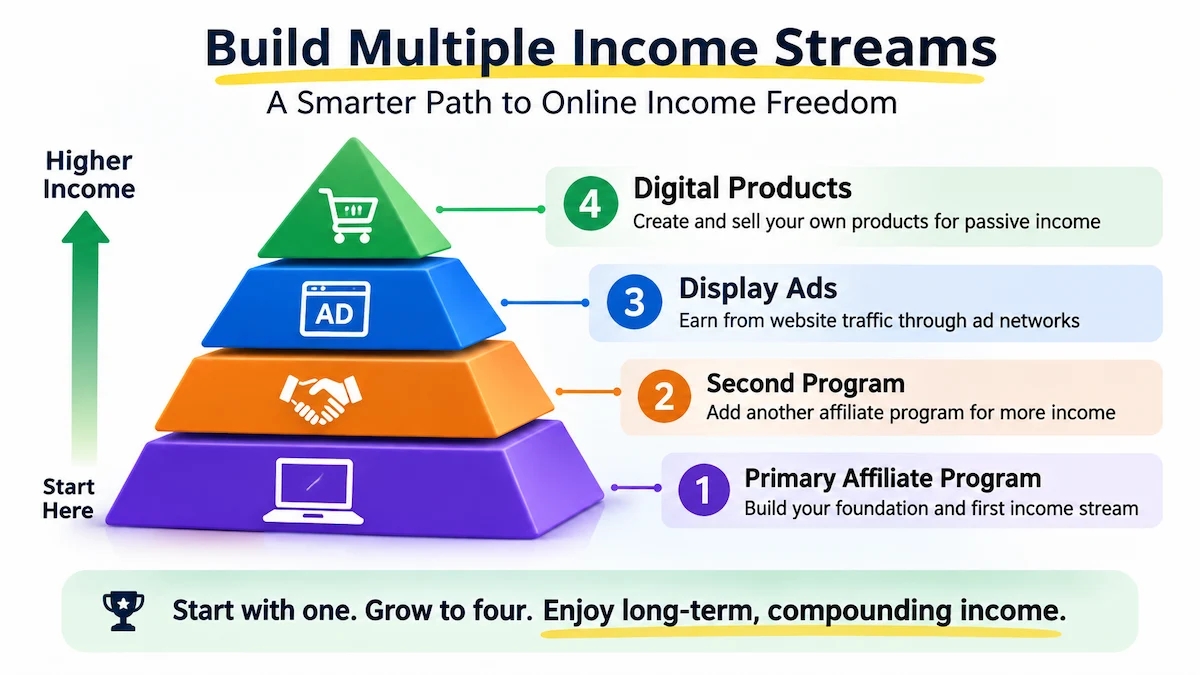
To diversify affiliate income by promoting more than one program within the niche, adding a second income method like display ads once there is a steady traffic, and eventually layering in a digital product once understand the audience well. The goal is not to spread thin across ten things at once. It is to make sure the income does not disappear if one program changes its terms, lowers its commission, or shuts down.
Most beginners never think about this until it happens to them. I want to walk you through how to build this in gradually, without turning your content into a scattered mess of random promotions.
This guide focuses on income streams within your existing content, not on spreading across new channels like YouTube or social media. Channel diversification is a related but separate strategy, worth its own look another time.
Table of Contents
Why Diversifying Affiliate Income Matters
I run two businesses side by side, a physical product business and an online affiliate marketing business built through Wealthy Affiliate.
Having both has taught me something that single-income advice rarely mentions. When one part slows down, the other keeps things steady.
That same principle applies inside affiliate marketing itself, not just across separate businesses.
Early on, I promoted mainly one program because it was what I knew and trusted. It worked, but I also noticed how much that single decision shaped everything else.
If commission terms changed or the program adjusted its structure, my entire content plan would have needed rethinking overnight. That is not a comfortable position to be in once you depend on this income.
Affiliate programs change their terms more often than people expect. Commission rates get adjusted, cookie durations get shortened, and sometimes programs close entirely with only a short notice period.
None of this is rare. It is fairly normal in this industry, and beginners who build around a single program are the most exposed when it happens.
Search engines are also rewarding sites that cover a topic thoroughly rather than promoting one product repeatedly.
A blog that only ever pushes one affiliate link across every post can start to read as one-note, both to readers and to search algorithms that value genuinely varied content.
Readers themselves respond better to balanced recommendations. A post that compares two or three legitimate options builds more trust than one that only ever points one direction.
Current Trends in Affiliate Diversification
More bloggers are combining affiliate marketing with display advertising once they hit a steady traffic threshold, rather than treating the two as separate strategies.
This gives a second income layer that does not depend on any single company’s affiliate terms.
Digital products, things like templates, short guides, or simple toolkits, are also becoming a more common third layer for established blogs.
They are not something a beginner needs on day one, but they are worth knowing about as a long-term direction once a blog has a real audience. There is also a shift toward niche-specific affiliate networks rather than only the largest, most generic ones.
Smaller, more targeted programs sometimes offer better commission structures for a specific audience than the big names everyone defaults to first.
Subscription-based affiliate programs are also becoming more common, where you earn a smaller recurring commission for as long as the referred customer stays subscribed.
These tend to build steadier income over time than one-off payouts, since a handful of retained referrals can keep paying monthly long after the content was published.
Search engines are also getting better at recognising genuinely comparative content, where a writer has clearly tested more than one option.
This rewards bloggers who take the time to understand more than one program properly, rather than defaulting to whichever pays the highest headline commission.
The Step-by-Step Roadmap to Diversifying Affiliate Income
Start with one program you understand well and build genuine content around it first.
Diversifying too early, before you have any real traffic or trust, usually just means spreading thin effort across multiple things that all underperform.
If you have not started affiliate marketing yet, the basics of picking that first program and building around it are covered in more detail here.
Once you have consistent traffic and a working content routine, look for a second program within the same niche that complements rather than competes with your first.
If your first program covers a broad category, the second one might cover a more specific tool or service within that same space, so you are adding depth rather than confusion.
When choosing a second program, check its commission structure, cookie duration, and payment terms properly before committing content to it.
This is the step beginners skip most often, and it is where a lot of wasted effort happens later when a program turns out to pay poorly.
Add display advertising once your traffic reaches a level where it is genuinely worth the setup, typically a few thousand monthly visitors. Before that point, ads usually generate too little to be worth the visual clutter they add to your pages.
Consider a digital product only once you understand your audience’s specific problems well enough to build something they would actually want.
This step comes much later than the first two and should never be rushed just because it looks like the next logical box to tick.
Throughout this process, keep your content genuinely helpful first. Every added income stream should still serve the reader’s actual question, not just create another place to insert a link.
Which Income Streams Fit a Beginner Affiliate Blog
Not every diversification option suits every stage of a blog, and knowing which ones make sense early versus later saves a lot of wasted effort.
A second affiliate program within the same niche is usually the most accessible first addition, since it needs no new traffic threshold.
It simply builds on content structures you already understand, which is why it is typically the right starting point once your first program is working.
Display advertising is a reasonable second layer once traffic supports it. It works passively in the background rather than requiring ongoing content decisions. It suits bloggers who want an additional stream without adding much extra workload.
Sponsored content or brand partnerships tend to come later still, usually once a blog has a clear enough identity that brands see genuine value in reaching your readers. This is not something most beginners need to think about in their first year.
Digital products sit at the far end of this progression, requiring the deepest understanding of your audience and the most upfront effort to build.
They can become a meaningful income stream, but they work best added once everything else is already stable, not as a starting point.
An email list works differently from the layers above, since it does not depend on any single affiliate program or search ranking staying in place.
Even a modest list gives you a direct way to reach readers if a platform changes its algorithm or a program adjusts its terms without warning.
Most beginners can start this early with a simple sign-up form and a short, genuinely useful lead magnet, long before traffic is large enough to support ads. It is a small, low-cost habit to build early, and it tends to pay off much later when you actually need it.
Once you have two or three income streams running, set aside time every few months to review how each one is actually performing.
It is easy to add a program and never revisit whether it still earns its place. Some will quietly underperform while others exceed expectations, and you will only know which is which if you check.
Keeping simple records of which links live on which posts also saves a lot of confusion later.
As your site grows, it becomes harder to remember exactly what is promoted where, and a basic spreadsheet makes reviews far less time-consuming.
Common Mistakes When Diversifying Affiliate Income
Adding too many programs at once is the most common mistake. It is tempting to sign up for five or six the moment you learn diversification matters.
Managing that many relationships, disclosures, and tracking links properly is more than most beginners can handle well, and content quality usually drops as a result. Choosing programs that do not fit your existing audience is another frequent trap.
A program might pay well on paper, but if it has nothing to do with what your readers came for, it will convert poorly and can damage trust. Ignoring the fine print on commission structures is a mistake that often only becomes visible months later.
Cookie duration, payout thresholds, and minimum sale requirements vary significantly between programs, and skipping this research can mean promoting something that pays far less than expected.
Rushing into digital products before understanding the audience well enough is another pattern I see often. A product built on assumptions rather than real feedback tends to underperform, and it can feel like a jarring shift if your content has been purely educational.
Treating every new income stream as equally important is a subtler mistake. Not every added stream needs the same amount of content real estate.
Your primary program should usually still get the most attention, with secondary streams woven in where they genuinely fit.
Never reviewing performance once a program is added is a mistake that tends to show up much later. A program that seemed like a good fit at the start can quietly stop converting, and without regular review, a blogger can keep promoting something that no longer serves anyone.
What I Have Learned From Diversifying My Own Affiliate Income
Running a physical product business alongside my online affiliate marketing work has shown me firsthand how much steadier things feel when income is not tied to one source.
It does not mean either side is easier. It means a slow month in one area does not automatically threaten everything. Applying that same thinking inside my affiliate content took longer than I expected.
It is easy to know intellectually that diversification is smart and still keep defaulting to the one program you already understand well, simply because building something new takes real effort.
What eventually shifted things for me was treating each new addition as its own small project, researched properly rather than added as an afterthought.
That slower, more deliberate approach produced better content and better fit than rushing to add options just for the sake of having more of them.
I will say plainly that diversifying does not remove risk entirely. It reduces how much any single change can hurt you.
It still requires ongoing attention to each program you are part of. This is not a set-and-forget strategy, even once it is in place.
There was also a period where I second-guessed whether adding a second program would dilute the trust I had built around the first.
In practice, the opposite happened, as long as the new addition was genuinely relevant and clearly explained rather than dropped in without context.
Readers seemed to respond well to honesty about why a second option existed, rather than feeling like they were being pushed toward more purchases.
Balancing my time between the two separate businesses I run has also shaped how I think about diversification within each one.
Neither business gets unlimited attention, so every addition to either has to genuinely earn its place rather than being added just because it was available.
Where to Learn More About Diversifying Affiliate Income
If you are still working out the basics of affiliate marketing before thinking about diversifying, it helps to start with a solid foundation rather than jumping straight to advanced strategy.
I have laid out the fundamentals tools on smartincome.pickyaura.com’s resource pages, that I utilize to build my business.
For structured training that covers both getting started and scaling into multiple income streams over time, Wealthy Affiliate is the platform I have used throughout building my own affiliate business.
It walks through this progression in a clearer order than trying to piece it together from scattered articles. You can start free and explore.
Final Thoughts on Diversifying Affiliate Income
Diversifying affiliate income is less about chasing every opportunity available and more about protecting what you have already built.
A single program can change its terms or disappear, but a blog with two or three well-chosen income streams supporting it can absorb that kind of change without falling apart.
Start with one program done properly. Add the next one only once the first is genuinely working, and choose it based on real research rather than whichever option looks easiest.
That patient, layered approach tends to build something far steadier than trying to diversify everything at once.
If you are just starting out and want the full path from choosing your first program through to building a sustainable structure, you can explore more on smartincome.pickyaura.com.
You can also look into the training I personally use here: Wealthy Affiliate
Looking at my own two businesses side by side has made this lesson stick more than any single article ever could.
Neither one carries all the weight on its own, and that balance is what lets me keep building steadily even when one side has a slower stretch.
Applying that same patience to how you build income streams inside your affiliate blog tends to produce something far more durable than chasing every option at once.
FAQ About Diversifying Affiliate Income
How many affiliate programs should a beginner promote?
One program is usually enough to start with. Adding a second is worth considering once you have consistent traffic and a clear understanding of your first program’s performance.
Is it risky to rely on just one affiliate program?
Yes, to some degree. Programs can change commission rates, cookie durations, or shut down with little notice, which is why building toward two or three complementary streams reduces that risk.
When should I add display ads to my affiliate blog?
Display ads are usually worth adding once you reach a few thousand monthly visitors. Before that, the income they generate is often too small to justify the added clutter.
Do I need a digital product to diversify affiliate income?
No. A digital product is one option, not a requirement. Many bloggers diversify successfully using two or three affiliate programs and display advertising alone.
How do I choose a second affiliate program?
Look for one that complements your first program rather than competing with it, and check its commission structure, cookie duration, and payment terms before committing content to it.
Can diversifying affiliate income hurt my content quality?
It can, if you add too many programs too quickly. Quality tends to drop when a blogger tries to manage more streams than they can properly research and write about well.
Is affiliate income diversification only for advanced bloggers?
No, but it works best once you already have a working foundation. Beginners are usually better served focusing on one program first, then diversifying once that foundation is solid.